
Beyond the Dead Hang: A Smarter Approach to Building Hanging Strength
Maybe you've seen those suggestions floating around social media and maybe even in popular news outlets that hanging is the best thing you can do for your shoulders. Or maybe you are an aerialist or a climber who wants to build strength in the gym and you saw somewhere that hanging for one minute is going to make you strong and better at your craft so you decide to start hanging.
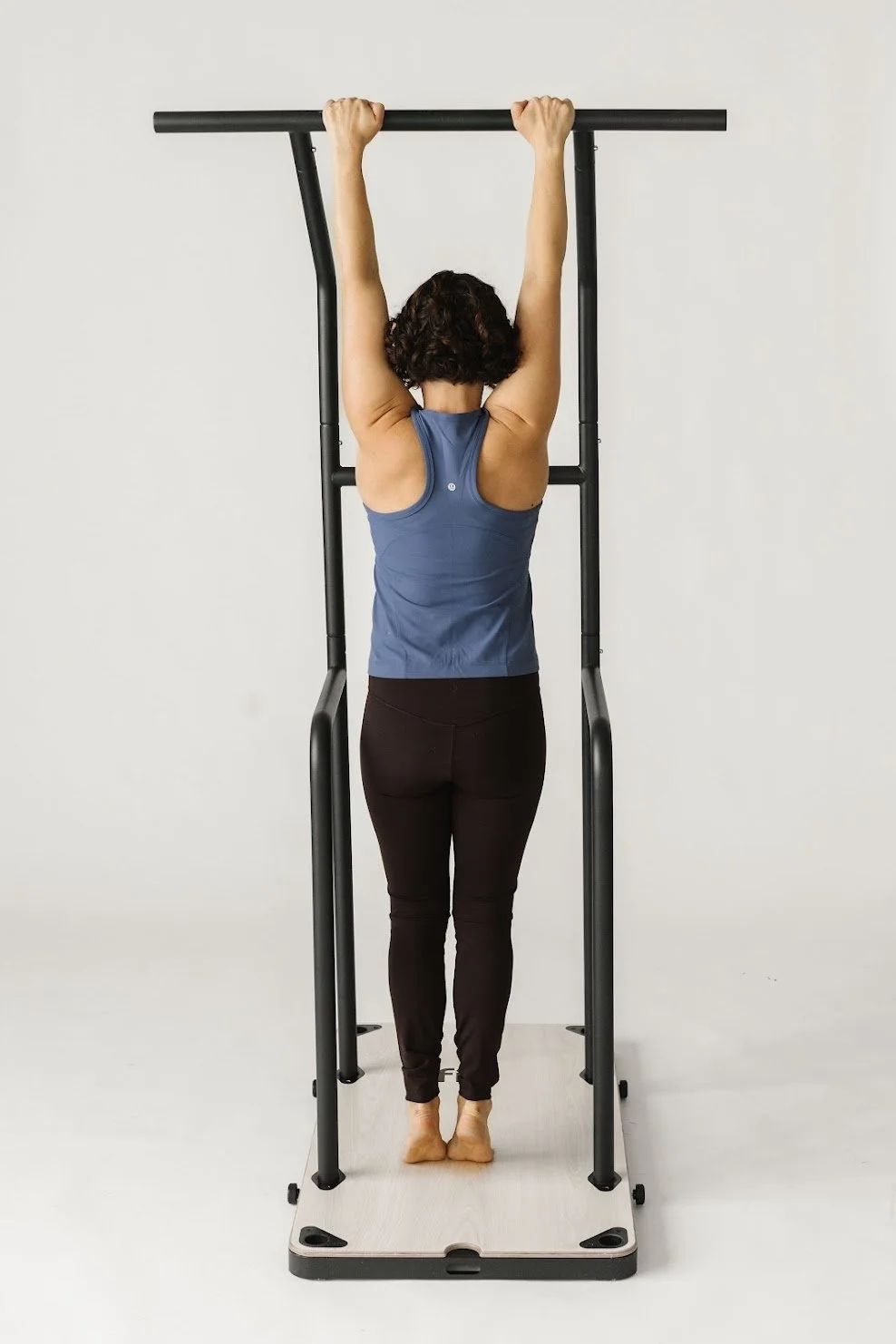
You watch the seconds tick by, which requires straining your neck because you are hanging from your hands and you feel a mild sense of strain in your hands, wrists, and shoulders. You try to remember to breathe as you wonder when 60 seconds became SO long? Or maybe your phone isn't actually counting down the seconds because it's frozen because of that update you never did?
Hanging has a lot of benefits. It builds stamina in the hands and capacity in the arms and shoulders. Kind of like standing straight up and down or coming into a squat, most of the time, it's a transitionary position, a moment before you move into a different position.
The act of hanging is something that can feel both physically strenuous and quite good. It's physically strenuous because your body weight is supported entirely by your hands. How challenging it feels depends on a number of factors, including:
• How you wrap your hands around the bar
• How you use your shoulders
• Whether you trust your hands to support you (this plays a larger role than you might think)
• The position of your rib cage in relation to your pelvis
• The width of the hands
Clearly, more goes into hanging than just "hang from a bar for [insert suggested amount of time here]." There is actual technique to it, and that technique is dependent on where you are going next.
When is Hanging Useful?
If you climb and you regularly need to hang from your fingers as you are propelling your body through the air to get the next hold, if you practice hanging from your fingers for extended periods of time, this can crossover to the grip strength you need for climbing (Mundry et.al, 2021).
Whether you perform a dead hang at 100% of your maximal finger strength or you perform intermittent repetitions at 80% or 60% of your maximal finger strength affects whether you see the most improvements in finger strength, stamina, or endurance. This is extremely specific to climbers, and studies usually use experienced climbers for this type of research (because who else is going to be able to hang from their fingers?).
The term for this type of hanging is hang board training, so we can safely say that hang board training is useful for people who climb things, but what about a standard dead hang? When is that useful?
Dead Hangs: What Does the Evidence Say?
Because I like evidence, I tried to find evidence on the benefits of a dead hang, which is simply hanging by your hands from a horizontal bar. The best thing I found was a paper from 1975 with 11 subjects (6 males, 5 females) that concluded after 2 weeks of performing dead hanging every day, muscular strength and efficiency increased (Brantner & Basmajian, 1975).
So did the psychological endurance of discomfort, which is what exercises are that have you stay in one position for an extended period of time—tests of whether you can endure discomfort.
Which brings me back to the original question—how useful is the dead hang in the context of someone who isn't using a fingerboard to train their fingers for climbing?
What Experience Has Taught Me
Here I veer from evidence to what spending thousands of hours working with clients and moving has taught me (because evidence is only as good as the practical application). Hanging is fun. For people who are brand new to hanging, it builds strength and endurance through the arms and hands. When taught in a thoughtful, focused way, a dead hang can improve upper body awareness and teach someone how to use both pressure in the hands and the rotations in the hands for support.
Hanging can definitely have a place, especially for people who haven't developed hanging specific strength. In fact, for people who are beginners in activities like climbing, aerial, or pole, or for someone who has the goal of being able to do a pull-up or chin-up, building up the strength, stamina, and capacity to hang from your hands unsupported is a logical place to start.
For people who can already hang from their arms, whether they need to be able to hang from their arms for a predetermined period of time is kind of like saying everyone should be able to hold a deep squat for a minute. It's a nebulous idea, based on one coach's perspective and it happened to gain traction because:
The coach has a large following
People who are into metrics and like a challenge
Neither of these things mean the idea is a good idea, or that hanging will magically improve the number of pull-ups you can do, your ability to do a straight arm invert, how well you climb up a pole, or improve which level climb you are able to do (spoiler alert—probably won't help with any of these things).
Once you have built the capacity to hang from your hands long enough that you can more confidently work towards your goals, unless you like long, uncomfortable isometric holds, there are other things you can do that I, personally, think are way more fun.
Building Your Hanging Endurance (in a way that doesn't feel like corporal punishment)
Hanging when you participate in activities like rock climbing, aerial, pole, or parkour is a transition to something else. Because it's a transition, it's a weight shift (because every transition is a weight shift).
So knowing that the transition is a weight shift, you can play with shifting your weight while you are hanging from your arms. The benefits of this are two-fold:
Makes Hanging Playful
Playing with the weight shift while hanging from your arms makes the act of hanging from your arms feel less like torture and more like play. You can even invent games to keep yourself engaged with the task. I offer some ideas below.Builds Practical Capacity
Exploring the weight shift builds capacity in different positions. The reality of any actual movement activity is you will use your hanging strength in unconventional ways (a common exit out of a back balance on aerial rope or silks, for instance, is essentially a one arm hang with your body changing its angle as you move the rope or silk around your body. The easiest way to train your ability to do this is to train that exit).
Having said that, exploring and exposing your upper limbs to different positions while you hang can make the real life application feel a lot less scary because your brain recognizes it as something that is familiar.
The Psychology of Effort
Before I offer some playful approaches to building capacity while hanging, there is one other factor to consider (and one that I have touched upon): whether something feels enjoyable or not is largely a mental construct (Hakim et al., 2022). Your perception of effort, which you can think of as your perception of how physically hard something is or is going to be, plays a role in regulating emotions and motivation.
I have no problem running up steep hills during my early morning outdoor runs; put me on a treadmill and crank the treadmill up to the same pace and the same incline, and I immediately find myself thinking about how miserable I am and wondering when I can stop. My perceived effort outside is very different than my perceived effort inside.
It should make sense, then, that an exercise like a dead hang is going to feel kind of miserable if you are doing it by yourself in a gym with nothing occupying your senses except wondering how much time you have left and the fact that your right hand feels like it doesn't have a good grip.
There are a number of factors that influence your particular exercise gestalt. Your internal body signals, like your sense of fatigue or discomfort, aka your interoception, are constantly competing with what's happening in your environment (Olsson et al., 2024). If the environment around you is positive, interesting, or in some way distracting, the noise from your interoception will be dialed down, which makes the hard physical thing you are doing feel easier.
There is a general prevailing belief in the fitness world that in order for something to be effective it must feel hard. In reality, if the task feels easier, you end up doing more work (because it doesn't feel hard) which means you actually build more capacity than if the task feels miserable.
Training doesn't have to be miserable to be effective.
This is directly applicable to an exercise like the dead hang. Building stamina and capacity, especially for people new to activities involving hanging, is rewarding. People can progress more quickly when they aren't limited by their hands, which makes training feel more gratifying. But here's the thing: training doesn't have to be miserable to be effective.
Try This:
See how long you can hang from a horizontal bar in a dead hang for. Write it down (or put it in your phone).
On a scale of 1-10, with 1 being physically and mentally unbearably uncomfortable, 5 being physically and mentally challenging, but doable, and 10 being physically and mentally rewarding, how would you rate it?
Do the two exercises shown below twice a week for the next month.
Recheck your dead hang time. Did it change?
On a scale of 1-10, how would you rate the experience now?
---
Spinal Intelligence drops soon. Sign up to be notified, or read more about it here.
---
References:
Mundry, S., Steinmetz, G., Atkinson, E. J., Schilling, A. F., Schöffl, V. R., & Saul, D. (2021). Hangboard training in advanced climbers: A randomized controlled trial. Scientific reports, 11(1), 13530. https://doi.org/10.1038/s41598-021-92898-2
Brantner, J. N., & Basmajian, J. V. (1975). Effects of training on endurance in hanging by the hands. Journal of motor behavior, 7(2), 131–134. https://doi:10.1080/00222895.1975.10735023
Hakim, H., Khemiri, A., Chortane, O. G., Boukari, S., Chortane, S. G., Bianco, A., Marsigliante, S., Patti, A., & Muscella, A. (2022). Mental Fatigue Effects on the Produced Perception of Effort and Its Impact on Subsequent Physical Performances. *International Journal of Environmental Research and Public Health, 19*(17), 10973. https://doi.org/10.3390/ijerph191710973
Olsson KSE, Ceci R, Wahlgren L, Rosdahl H, Schantz P (2024) Perceived exertion can be lower when exercising in field versus indoors. *PLOS ONE 19*(5): e0300776. https://doi.org/10.1371/journal.pone.0300776