
Rotational Anchors: How Your Hands Make Movement Easier
How can you use your hands to make movement on the ground and in the air easier?
What lowers you to the ground in a smooth, fluid way when you are doing a push-up?
What supports you while you are upside down in a handstand?
And what enables you to swing, turn, and flip upside down when you are on a bar, a rope, or a pole?
At this point (especially if you have read any of my previous blogs on movement), you know the body is connected. When we move, there is a coordination of body parts that occurs to create the movement based on the sensory input the body has. If you change the sensory input, you change the corresponding output which, in my world, is always movement.
But (and there's always a but) the sensory input is dependent on sensory receptors in the skin, muscles, tendons, and joints. In fact, because the hands connect us so intimately with the world around us, the skin is particularly sensitive. There are 17,000 touch receptors and free nerve endings in the palm that pick up sensations like pressure, vibration, and, of course, movement.
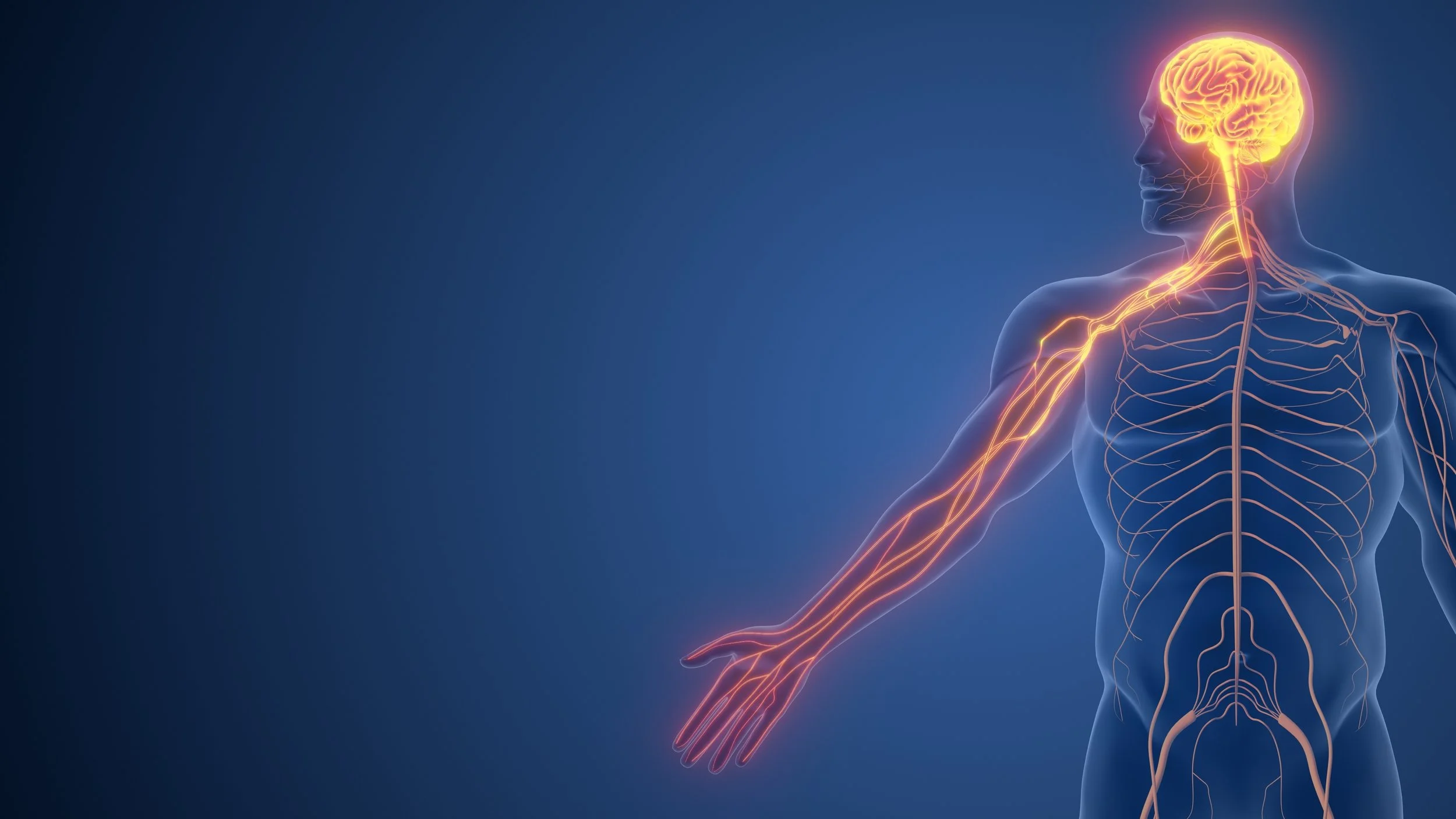
All of this sensory information gives the brain information about movement sense. Movement sense is your sense of motion, direction, dynamic position, and velocity.
You could also think of this as your felt sense of a specific movement.
I do aerial silks and rope. When I am learning a new movement, it is not unusual for me to feel like I am doing it exactly like the teacher demonstrated it, only to watch video feedback and see my knees are bent, the speed is uneven, and my coordination more closely resembles a penguin's than a dolphin's.
My perception or movement sense doesn't match what actually happened, making it inaccurate. As I become more adept at the movement, it becomes easier to track my motion, direction, dynamic position, and velocity, making my movement sense more accurate.
This is true of any movement you train, whether it's a weightlifting exercise, bodyweight flow, or athletic skill. Learning to place your attention on different components of your movement can hone your movement sense accuracy and make you more in tune, literally, with what you are doing when you move.
Back to the subject at hand (no pun intended)
When you hold something, the hands become a sensory goldmine of information for the premotor cortex in your brain, determining how the levers in your arm will coordinate whatever movement you are doing. Part of this coordination is predicated on the job your hand likes to do.
Our hands work together to create coordinated movement. This means the brain coordinates the sensory output for the left hand and the right hand in a way that makes sense for the desired task, taking into account all of the sensory information it has from each hand. The two sides of the brain work together, kind of like the CEO and COO of a large organization, to figure out the best way to grip, rotate, pull, push, or reach based on the sensory input, which you can think of as reports that the CEO and COO are getting in real time from the managers of all of the different departments. In this analogy, the managers are the nerves that are collecting that information I mentioned earlier. The CEO and the COO are the motor cortices in the left and right side of the brain.
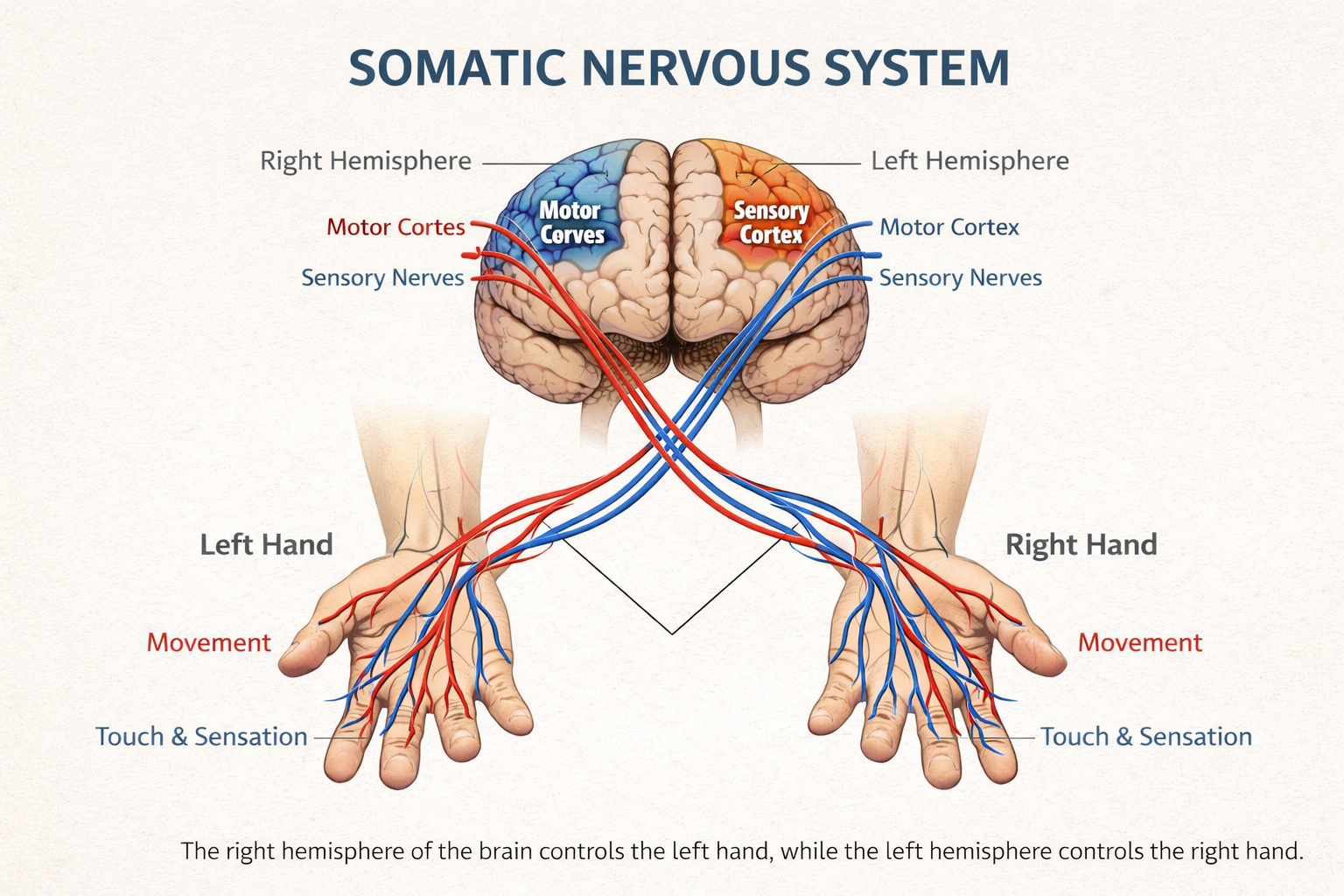
AI generated image—for some reason, the nails are on the wrong side of the hands…
This inter-organizational system is called neural coupling. The CEO and the COO are receiving different reports, since the left hand and the right hand are never doing the exact same thing. This is because the body is set up to perform complementary movements to maximize coordination. If both sides functioned and moved in exactly the same way, that would be redundant.
Redundancy can be helpful to create a back-up if a system fails. That's why genes can duplicate, but a duplicated gene is only retained if it's adopted for some additional role, like the second person hired to be an executive assistant for the same team is only kept on if they can pick up some other duties.
That's because redundancy is inefficient, and biological systems need efficiency to survive. Most people have a left and a right hand. One hand holds the paper. One hand holds the pen. One hand holds the bottle. One hand twists off the top. Each hand is specialized, like the subject matter expert in the organization. These simple, coordinated movements allow you to move through your day easily, without extra thought or effort. They are experts in different subjects that are complementary, enabling them to maximize the function of the organization.
In the context of more skilled-based or attention-based movement, the hands can direct the movement of the arms, though how each one does this will look slightly different than the other.
Before I get too far ahead of myself, try this:
Place a light object in your right hand.
Toss the object up and catch it a few times. Notice how much your wrist moves.
Place a light object in your left hand.
Toss the object up and catch it a few times. Notice how much your wrist moves.
Which wrist moved more?
Generally, one wrist moves to flip the hand and toss the ball up and one wrist moves a lot less so the arm tosses the ball up. One isn't right and one isn't wrong. They are simply different strategies to accomplish the same thing.
Another way to think of this is if one hand can't toss the ball because it's injured or impacted in some way, the other hand can still accomplish the task. This allows the system to be resilient but not redundant.*
*These concepts come from Adarian Barr’s Dyad System.
The role of the hands when they are fixed
So far, you have learned:
You have something called a movement sense
Your hands are sensory rich
Your hands work together and can do the same things, but they do them differently
When your hands are on the ground, you can take advantage of these facts to create fluid movement towards and away from the ground. If you imagine the thumbs are rotating away from each other as you lower your chest towards the ground, it's like you are making space for the chest to move into. If you imagine the thumbs are rotating towards each other as you push away from the ground, you are eliminating that space, which moves your torso up away from the floor.
If you know which hand likes to flip to toss the ball, you can emphasize rotating that thumb out as you lower down and you can emphasize rotating towards the thumb of the other hand as you move up.
In the video below, I use the concept of creating the rotation in the hand in a flow sequence. I can take advantage of both hands to facilitate the rotation into different positions. How I do this depends on which hand is anchored.
I can use these concepts to cartwheel, rotate into a backbend, or push myself up into a standing position from the ground. We do a lot of this naturally, without thinking about it. Paying a little bit of attention to it, once in a while, hones our movement sense.
When you hang from something horizontal, create tension by pretending you're breaking the bar in half—rotate the pinkie side of each hand towards the bar and the thumb side towards the bar (assuming your thumb is wrapped under). As you pull yourself up, the hand that flips to toss the ball can also roll towards the bar, making the pull feel lighter.
If you are holding a vertical apparatus, like a rope or pole, your hands will naturally rotate outwards to create the necessary tension to stay on the apparatus. The flipping hand generally rotates a little extra as you invert or pull up, while the other hand holds steady—another way to think of this is one hand generates the movement, the other hand maintains the stability. Both roles are important. You don't need two hands that do the same thing.
The short video sequence below is a way to begin sensing what your hands are doing in different positions. The movements are slow, giving you time to focus and fully experience the sensations; once you have a more clear image in your brain about what your hands are doing, try a more dynamic movement. How is your experience different?
Interested in learning more about rotational anchors and how to apply them? I'm running a live, online Hand to Bar Workshop on February 14, 2026. Details here.