
Why Back Squatting Doesn't Work for Everyone — And What to Do Instead
I talk to Emily at least four times a week. I have known her since I was two, and I have watched as her career has accelerated, all while raising three kids.
Emily doesn’t have a lot of time, but the one thing she does is make sure she exercises. She does it first thing in the morning, before work, while the kids are still sleeping. Several months ago, she joined a gym that offered CrossFit style workouts.
After the first workout, Emily was intrigued. She had never used a barbell before and she liked the way it made her feel. She went consistently and immediately felt herself getting stronger.
The workouts are designed to be physically challenging so she feels like she actually did something. Emily is in her 40s and doesn’t have any interest in getting hurt, so she modifies when the challenge feels like it’s greater than her capabilities.
One morning, the workout consisted of barbell back squats and overhead presses. Emily did the workout as written. In the car on the way home, she noticed her back didn’t feel quite right.
As the day progressed, her back got worse. She called me, asking for advice and wondering how she did it. “You probably did it with the barbell back squats. Wait 72 hours. Use heat. Don’t use ice. Walk if you can tolerate it. It should feel better.”
*I am not a medical professional. What I offered Emily came from knowing her movement patterns over many years, not from a clinical assessment. If your back is unhappy, a healthcare provider should be your first call — not your sister.
Sure enough, after 72 hours her back felt a lot better. She asked me what she should do moving forward so that it doesn’t happen again. “Whenever back squats are programmed, do front squats or Zercher squats. Back squats don’t agree with our structures.”
Before anyone comes after me with some sort of blunt weight because they think I am putting down their favorite, most effective lift, I am not saying that back squatting is bad for you. I am saying that back squatting doesn’t work for everyone and that that’s okay. There are LOTS of ways to squat, which is the point of this post.
A brief history of the back squat (that most fitness content skips)
Back squatting is a relatively new exercise. Squatting flat footed, actually, wasn’t something people were doing in the late 1800s and early 1900s. The fitness influencers at the time were squatting on their tip toes and they didn’t have access to heavy weights—the dumbbells they had access to usually didn’t weigh more than 10 pounds. Squatting on their toes was a way to increase the tension on the thighs in the absence of heavier loads.
In the early 1900s, Alan Calvert, a businessman interested in fitness, had a problem to solve. Barbells were becoming a popular strength training tool in Europe, but in America, where Calvert lived, barbells were non-existent. Calvert wanted access to these tools. A business idea was born.
Calvert’s solution (like any good entrepreneur) was to form a company that sold barbells and, like any good fitness professional, provide a course that taught people how to use them. Milo Bar-bell Company was born in Philadelphia in 1902.
The barbell spread, and with it, came an explosion of techniques.
The initial squat taught by the Milo Bar-bell Company using a barbell on the back was with the heels turned in and touching, squatting all of the way down. It resembled a plié squat or deep knee bend, only with a barbell and some weight on the back.
This lasted until Calvert was introduced to Henry ‘Milo’ Steinborn. Steinborn came to America from Germany after World War I. He brought with him a love of lifting heavy things. In addition to pressing cars with his legs, he liked to put barbells on his back (an impressive feat by itself since this was the era before squat racks) and squat up and down. You can’t lift something heavy with your heels together and lifted, so with Steinborn came a new squatting technique.
People have always been enamored with feats of strength, and Steinborn’s ability to squat 553 pounds and back lift an 800 pound elephant at Chicago’s World’s Fair when he was 57 years old caught people’s attention.
Random fact: in 1921, when Steinborn was featured in Strength magazine, Alan Calvert wrote about Steinborn’s incredible strength and physique through weight training and pointed to the new “squat” lift Steinborn was doing. This is one of the first times the word squat was used as a name for a weightlifting exercise, making the barbell squat as we know it about 105 years old.
Initially, the barbell squat was a novelty. It was a circus trick, something the performers trained so they could impress onlookers. Eventually, adjustable barbells became more widely available and people wanting to emulate impressive feats of strength began including barbell squats into their strength programs.
What’s actually happening when back squatting creates problems
Think about how Steinborn originally got under a barbell, before squat racks existed. He had to lean to one side, get under the bar, and then push upward. The lift started from the bottom.
When he back-lifted the elephant, same principle: the elephant was elevated, he got underneath it, and pushed up from there.
In both cases, the movement begins in a squatted position. You go down in order to go up.
Now consider what happens in a modern rack. You start standing, then step under a loaded bar. Your brain immediately registers that there’s pressure on your back, and it responds by creating space, by pushing into the bar. Everyone does this a little differently. Some people shift their head forward. Some people shift their pelvis back. Some people, like Emily and me, push the upper back backward.
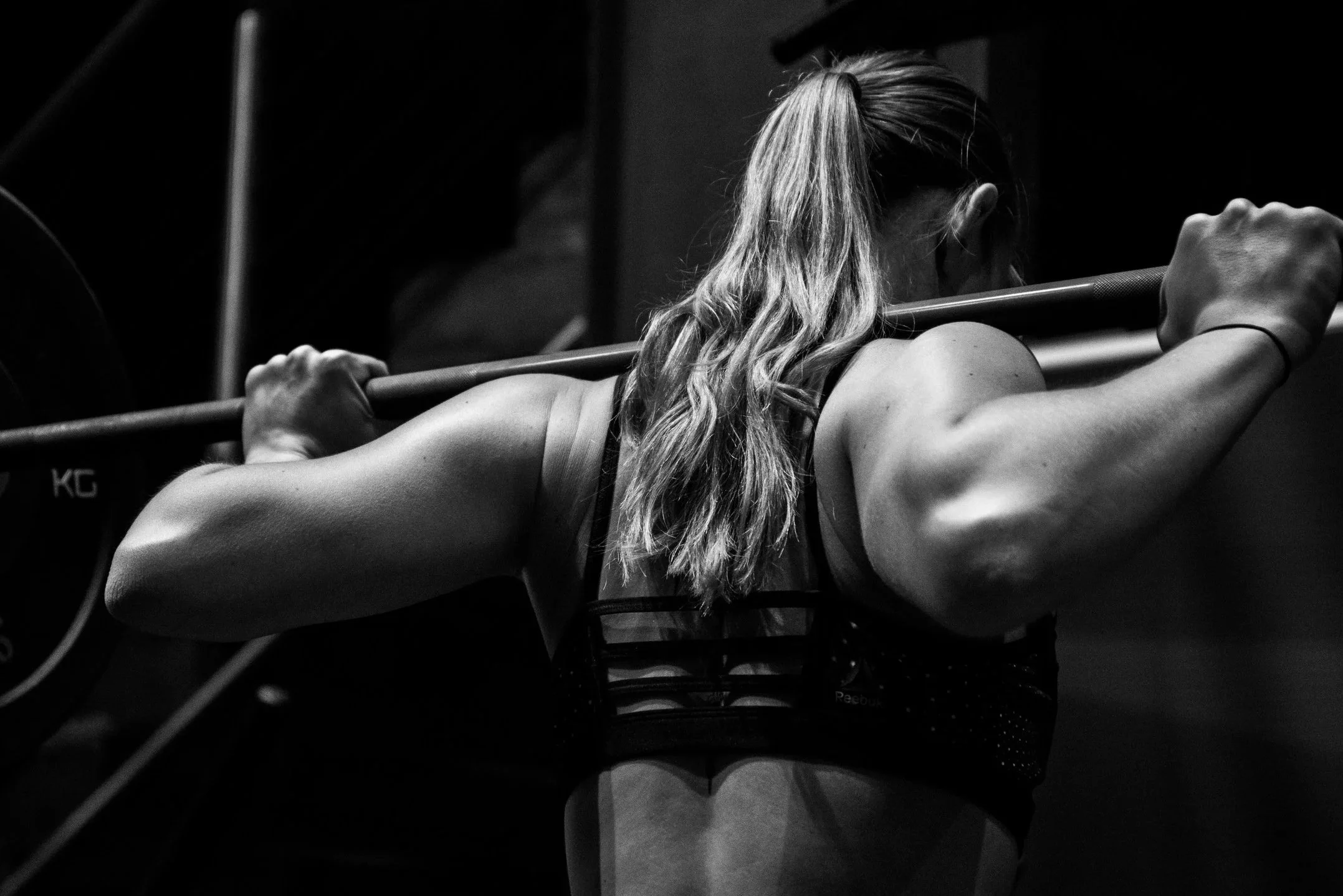
Standard starting position for a barbell back squat. Notice she moved her head forward to accommodate the bar.
None of these responses is wrong. They’re the nervous system doing exactly what it should: managing the load. The tension created is actually supportive. The problem arises when that tension doesn’t release. Sometimes, like in Emily’s case, this creates pressure somewhere else, like the low back. For me, my back becomes like an arched rod, which doesn’t work very well for my other movement hobbies.
This isn’t a form problem. It’s a structural and neurological reality. Some people’s bodies simply distribute load from a back squat in a way that works against them.
The good news: there are a lot of other ways to squat
If back squatting creates issues for you, you don’t have to squat with a barbell at all, unless you genuinely enjoy it. And if you do want to squat with a barbell, you don’t have to put it on your back (unless you enjoy that, too). You can hold it in front of you on your shoulders, in front of you in your elbows, or try some other variation that feels challenging in a good way.
And if you are doing a back squat, you can even start with the barbell lower, so you start in a squat position instead of a standing position. You might have to use lighter load, but it also might feel different, in a good way.
Most of the heavy things we carry in the real world aren’t placed horizontally across our upper backs. When we give the body a loading pattern that makes more intuitive sense, it often responds better.
If you’re in a group class or gym setting and the programmed squat isn’t working for you, you’re allowed to substitute. If someone questions it, you don’t owe them an explanation. The point of training is to feel better in your daily life, not to force a variation that doesn’t fit your body.
The takeaway
Back squatting is 105 years old. It was invented by a circus performer who wanted to lift increasingly heavy things, popularized by an entrepreneur who sold barbells, and eventually became so embedded in strength culture that many coaches treat it as non-negotiable.
It’s a good exercise. For a lot of people. Not for everyone.
You have options. Use them.
For ideas on a couple of different squat variations, see the video below.
Jenn Pilotti, M.S., is a movement educator and author of Spinal Intelligence. She works with intelligent, high-performing people at the intersection of neuroscience, somatic movement, and physical fitness. jennpilotti.com